



The questions that fill up our webinar Q&A are almost never about obviously fake letters. They're about the situations that don't fit a checklist: a renewal, a new animal, a provider who won't call back.
At our ESA Verification 101 webinar, property managers asked some of the best questions weI've heard. Here are six of them, with how we handle each one after reviewing thousands of requests a month. I'm not a lawyer, and this isn't legal advice. It's what we've learned works.
1. You approved an ESA, then realized the documentation was weak
It happens, especially after a team gets trained on a stricter standard. In most cases, leave the approval in place for the current lease. When the resident renews, ask for reliable documentation under your current process.
The exception is behavior. If the animal is causing issues at the property, like aggression or persistent noise, the approval can be revisited sooner. Revoking mid-lease only because the paperwork now looks thin has been done, but it tends to draw pushback.
2. The letter might have expired
There's no national rule on ESA letter expiration. One state has set a standard; the other 49 haven't.
In practice, many providers, including online letter websites, put a one-year expiration date on their letters. If that date has passed by renewal, asking for current documentation is a reasonable, obvious step.
Age alone doesn't make a letter unreliable, though. We've followed up on letters written ten years earlier and had the provider confirm the recommendation still stands. At that point, it's still reliable documentation.
3. The ESA passed away and there's a new animal
The answer lives in the original letter. If it says the resident needs "a dog," a new dog is hard to question. If it names a specific animal, it's reasonable to confirm through the interactive process that the new animal also alleviates symptoms of the disability.
Handle it gently. The resident has just lost an animal that mattered to them.
4. The ESA doesn't fit your pet policy
ESAs aren't pets, so breed, weight, and animal-count limits in a pet policy don't automatically apply.
What does apply is reasonableness. Two examples from real situations:
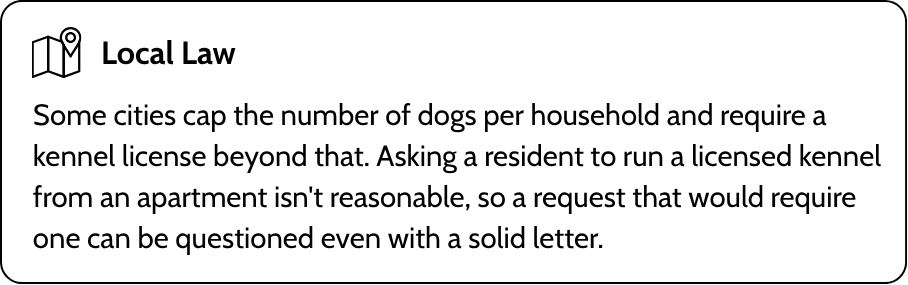
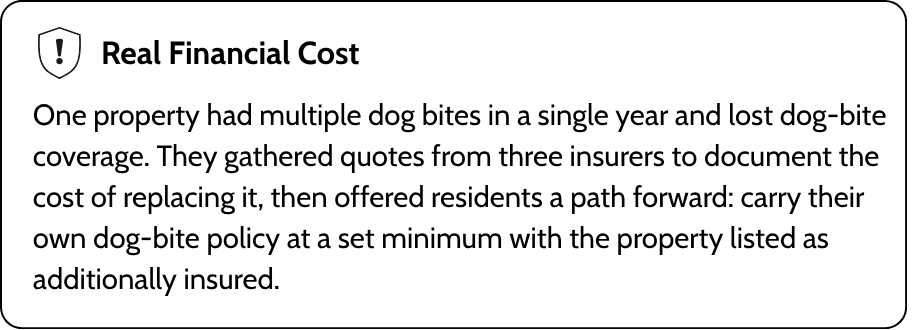
Notice the pattern: documented reasons, and an alternative offered.
5. The provider isn't responding
Ask yourself what's reasonable. A provider on a two-week vacation is a normal delay. A letter with no contact information at all can't be verified, and that's a different situation.
Sometimes there's no good answer. We once handled a recent letter from a sole practitioner who had tragically passed away. There was no one left to confirm it, and the letter was recent. We approved it
6. A resident found a second provider after the first said no
This one came from a team running permanent supportive housing. A resident's therapist declined to support an animal, so the resident found a different provider with no prior relationship and got a letter.
If the new provider confirms a disability and a disability-related need, that letter is hard to argue with unless you have evidence it was obtained in an unreliable way, such as being purchased online. What you can do is make sure your follow-up confirms the provider actually evaluated the resident. And if a provider appears to be writing letters without real evaluations, report it to their licensure board with the details.
A note on multiple animals
Multiple assistance animals can be completely legitimate. Two roommates may each have their own need. One resident may have a dog that helps with depression by getting them outside and a cat that helps them through panic attacks.
The request still has to be reasonable. We've seen requests for six cats. The fair question is what each additional animal does that the first one can't.
The pattern behind all six
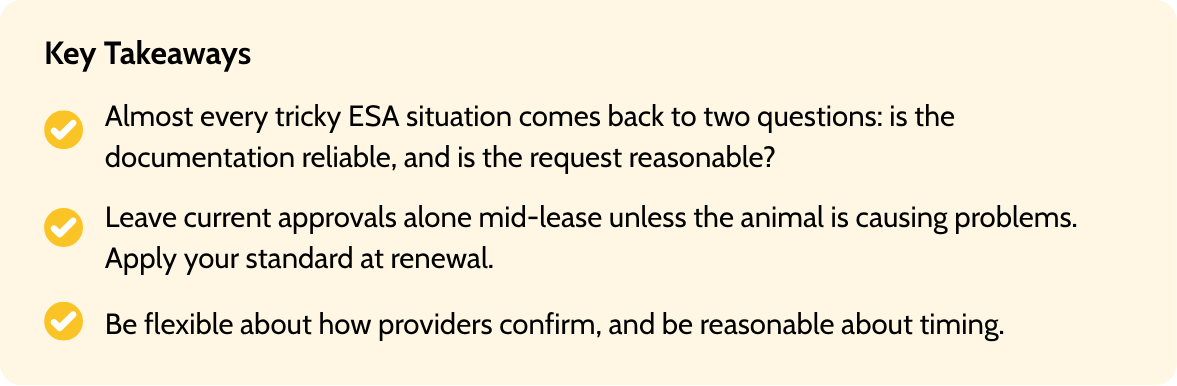
Every situation above came back to the same two questions: is the documentation reliable, and is the request reasonable? Teams that answer both the same way at every property, and write down how they got there, rarely end up on the wrong side of a complaint.
We collected these scenarios, along with the full documentation standard and interactive process, in our free field guide.
FAQ
1. Can we revoke an ESA approval mid-lease?
Generally only when the animal is causing issues at the property. Documentation concerns are usually best handled at renewal.
2. Do ESA letters expire?
There's no national standard. Expired letters at renewal are a reasonable trigger for current documentation.
3. Do ESAs have to follow breed and weight restrictions?
Not automatically, because they aren't pets. A specific request can still be unreasonable because of local law or a documented financial burden.
4. What if the provider never responds?
Judge what's reasonable. Allow for normal delays; a letter with no way to contact the provider can't be verified.
Disclaimer: For informational and educational purposes only. Not legal, financial, or professional advice.


